The text of this picture book is barely adequate to carry the illustrations; but what illustrations they are! Dom Lee's "scratched beeswax and oil paint" pictures recreate the somber but not hopeless tone of the Japanese-American internment camps of World War II. This little book can help us and our children's children not forget. Text by Ken Mochizuki. Quality = 3; Acceptability = 5. Talking points: race relations; baseball.
Tuesday, April 15, 2008
Baseball Saved Us
The text of this picture book is barely adequate to carry the illustrations; but what illustrations they are! Dom Lee's "scratched beeswax and oil paint" pictures recreate the somber but not hopeless tone of the Japanese-American internment camps of World War II. This little book can help us and our children's children not forget. Text by Ken Mochizuki. Quality = 3; Acceptability = 5. Talking points: race relations; baseball.
Sunday, April 13, 2008
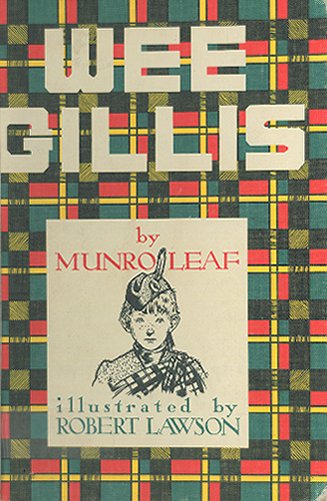
Wee Gillis
So, with five or six thousand new children's books published each year, why recommend one that is 80 years old? Several reasons. Who cares how old a story is if it's a good one? This one, by the author of the award winning The Story of Ferdinand, is a good one. Robert Lawson's black and white drawings carry the story well.
But what I most like about Wee Gillis is the Christian worldview lesson to be learned--the Almighty wastes nothing; He will use adversity in our lives to get us ready "to do good works, prepared in advance for us to do." Did Munro Leaf have this in mind as he wrote the story? I'm sure he didn't, but that is just the point. Common grace says that all people experience some of the grace of God, regardless of their religious convictions, simply by being created in His image and living in a world that He made and ordered. If we have eyes to see and ears to hear, we will see truth everywhere. Even if the artist doesn't.
Quality = 5; Acceptability = 5.
Thursday, April 10, 2008
How many ways can you say "compromised"?
So there I was, plowing through the kid's books at Goodwill, hoping for some 99 cent treasures. Bingo. Four volumes of Beatrice Potter's Peter Rabbit stories, in like new condition. Sold. But wait, here's another, an "adaptation". What, we're going to shorten these stories, edit them, put several original pages on one page? Please! Avoid books that use these terms: adapted by; abridged; based on; re-told. (There is one class of exceptions. Since folk tales and legends were, by nature, spoken rather than written, they can frequently be re-told in contemporary grammar without compromising the story.) For the rest, for the classics, avoid adaptations. If necessary, wait to read them until your children are ready for the real thing. You, and they, won't be disappointed.
Question: Are there exceptions to my rule? (Abridgments or adaptations that are actually preferable to the originals)
Tuesday, April 8, 2008
Don't miss Magers and Quinn
It's great to be home after two weeks of traveling (my excuse for not posting recently). My first ever visit to Washington D. C. and New York City with our school's 7th and 8th graders was amazing and blessed in every way. I'll travel with that group anytime!
After a brief 18 hours at home, my wife and I headed back to SeaTac to spend a few days with our younger daughter Kari in Minneapolis. It is still winter in Minnesota, but we thoroughly enjoyed walking each day. (Kari is trying to complete all 60 Walks Within 60 Miles of the Twin Cities--only twelve to go, before she moves back to Washington this summer!)
Which leads me back to the subject of books; in particular, kid's books. If you go to Minneapolis, don't miss Magers and Quinn-a terrific new and used bookstore on Hennepin St. That's where I picked up a couple of treasures: a fairly clean copy of G. K. Chesterton's Coloured Lands, Rock Crystal by Adalbert Stifter (more on that one another day), and an excellent collection of essays on kid-lit-crit: Only Connect. I'm hoping that the essay book will lead to a presentation on the history of children's books at our Christian teachers convention next Fall.
Monday, April 7, 2008
From "The Dragon's Grandmother"
The soul is sane "but the universe is wild and full of marvels. Realism means that the world is dull and full of routine, but that the soul is sick and screaming.... In the fairy tales the cosmos goes mad; but the hero does not go mad. In the modern novels the hero is mad before the book begins, and suffers from the harsh steadiness and cruel sanity of the cosmos."
G. K. Chesterton essay, quoted in Only Connect, p.155
Saturday, March 22, 2008
Genius, according to R. L. Stevenson
"I am not a man of any unusual talents; I started out with very moderate abilities; my success has been due to my really remarkable industry--to developing what I had in me to the extreme limit. When a man begins to sharpen one faculty, and keeps on sharpening it with tireless perseverance, he can achieve wonders. Everybody knows it; it's a commonplace, and yet how rare it is to find anybody doing it--I mean to the uttermost as I did. What genius I had was for work!"
Quoted in The Green and Burning Tree, by Eleanor Cameron.
Thursday, March 20, 2008
The Van Gogh Cafe: This Week with Cynthia Rylant
"The Van Gogh Cafe brings out the best in people.." But I'm not sure it brought out the best in Cynthia Rylant. Publishers Weekly said, "Readers will share the wonder of ten-year-old Clara and her father Marc, the cafe's owner, as they witness a series of serendipitous occurrences involving stranded seagulls, aged film stars, magic muffins, lost pets, and mysterious travelers." I think it was the gluttonous seagulls and aged film star that lost me toward the end.
School Library Journal enthused- "A lovely title that's perfectly suited to all readers who can recognize the special magic of the world around them." Of course it is lovely; Rylant will not, perhaps cannot, produce anything else. It's the special magic that I'm unsure of. What do you think of this kind of "magic"? Is it similar or different from the kind of magic in, say, Narnia?
Reading level = 4.5; not recommended.
Wednesday, March 19, 2008
Missing May: This Week with Cynthia Rylant
Deservedly the winner of the 1993 Newbery Award (and many others), this is the story of a death in an unusual family, a family that God brought together out of the mutual need of its members. The book is PG on our shelves, due to mild profanity and a (futile) attempt to contact the dead. I use it, with some editing, as a middle school read-aloud. Another sensitively written story from a great writer. Reading level = 6.7; Quality = 5; Acceptability = 3.
Tuesday, March 18, 2008
The Relatives Came: This Week with Cynthia Rylant
Monday, March 17, 2008
The Blue Hill Meadows: This Week with Cynthia Rylant
Cynthia Rylant is one elegant writer--she handles words with clarity, ease, and great sensitivity; and she does it across a surprising range of reading levels. This book includes four stories of the Meadow family, drawn from the author's childhood in the Appalachian Mountains. Ellen Beier's interspersed watercolors set just the right tone. A good read-aloud for younger children.
Reading level = 4.5; Quality = 5; Acceptability = 5.
Subscribe to:
Posts (Atom)