Thursday, April 24, 2008

Beware the sausage vendors


"How sad it is that writers whose books are, on the whole, worthless, produce them like sausages out of a machine, whereas the real artists among children's writers (with few exceptions) write so few."
Frank Eyre, British Children's Books in the Twentieth Century, p.150. 1971
Want to take a run at naming today's "sausage vendors"?
Or, perhaps more usefully, who do you consider to be "real artists among children's writers" today?

Lizzie Bright and the Buckminster Boy


Three months ago, Gary D. Schmidt learned that his latest youth novel, The Wednesday Wars, had won a coveted Newbery Honor. This is the Calvin College Professor of English's second such award. He previously won it for Lizzie Bright, a finely crafted and beautifully phrased story of friendship and courage drawn against racial bigotry. Sprinkled profanity and a brave, but ultimately unsatisfying attempt to be fully human from an evolutionary worldview make this work not appropriate for our younger students. But, I ask you, where else is a kid going to learn the adjective "hugger-mugger"? (Yes, it is in the dictionary.) Quality = 5; Acceptability = varies with age of reader.

Saturday, April 19, 2008

SAQ #1: What are SAQs?

SAQs are "Seldom asked questions."
Francis Schaeffer used to say something along the lines of, having correct and useful answers is to no avail if people aren't asking the right questions. So, from time to time I will answer a question that no one has asked.
Thanks for asking.

Friday, April 18, 2008

What is it about Alphabet books?


Other than fables, legends and fairy tales, no genre or type of kid's books has been more enduring or perennially popular than Alphabet Books. There are thousands; did you know? You are probably familiar with several--perhaps Lobel's On Market Street; Graeme Base's Animalia; or Dr. Seuss's On Beyond Zebra.
Since their inception, alphabet books have fallen into one of two broad categories-those intended to teach children the letters as a prelude to reading; and those books that use the format as a way to organize information around a common theme. The latter, of course, are more sophisticated and frequently satisfying for readers of any age. A few to consider: O is For Orca features the stunning photography of Art Wolfe as he A-B-Cs his way around the Pacific Northwest; Leslie Tryon's first book, Albert's Alphabet is a wordless book. (Booklist says, "Children (and their parents) will enjoy pondering Albert's various construction techniques and marvel at his ingenuity."
One of our family's current favorites is A Mountain Alphabet, with well-crafted paintings by Andrew Kiss that invite searching for hidden letters as well as items that begin with each letter.
If you enjoy woodcuts, Mary Azarian's A Gardener's Alphabet is worth a close look.
And my favorite simple A-B-C was compiled by Seattle artist Cooper Edens. The Glorious ABC reproduces illustrations by thirty different great children's book artists of the past, including Caldecott, Greeenaway, Potter, Rackham, and Parrish.
I've been trying to resist the temptation to collect Alphabet Books; just in case I fail, what is your favorite?

Thursday, April 17, 2008

Innocence is what you make it.


Patricia Polacco's Just Plain Fancy is chock-full of the friendly folks and animals we have come to expect from her. Her illustrations are always full of life and action, without being frantic. This story of the "plain folk" and an unexpected fancy bird is the kind of work that can help us nurture a healthy innocence in our children. More on that subject another day. Quality = 5; Acceptability = 5

Tuesday, April 15, 2008

Too many (mediocre) books for kids!

Even half a century ago, an unnamed whiner in the London Times Literary Supplement proposed:
"Writers should every now and then be rigidly kept from writing for a year. If at the end of that time they have a nervous breakdown from frustration, they should be allowed to write. If, on the other hand, they are quite fit and happy, they should be put on to office work, knitting, gardening, or some other pleasant occupation, permanently and full-time. This would be fairer to children."

Baseball Saved Us


The text of this picture book is barely adequate to carry the illustrations; but what illustrations they are! Dom Lee's "scratched beeswax and oil paint" pictures recreate the somber but not hopeless tone of the Japanese-American internment camps of World War II. This little book can help us and our children's children not forget. Text by Ken Mochizuki. Quality = 3; Acceptability = 5. Talking points: race relations; baseball.

Sunday, April 13, 2008

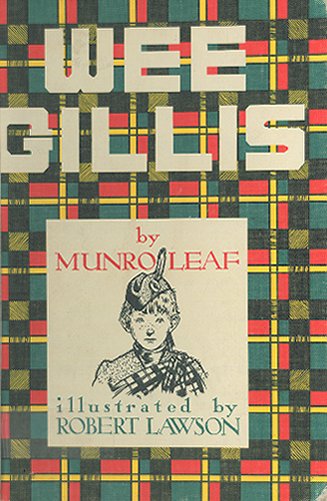
Wee Gillis


So, with five or six thousand new children's books published each year, why recommend one that is 80 years old? Several reasons. Who cares how old a story is if it's a good one? This one, by the author of the award winning The Story of Ferdinand, is a good one. Robert Lawson's black and white drawings carry the story well.
But what I most like about Wee Gillis is the Christian worldview lesson to be learned--the Almighty wastes nothing; He will use adversity in our lives to get us ready "to do good works, prepared in advance for us to do." Did Munro Leaf have this in mind as he wrote the story? I'm sure he didn't, but that is just the point. Common grace says that all people experience some of the grace of God, regardless of their religious convictions, simply by being created in His image and living in a world that He made and ordered. If we have eyes to see and ears to hear, we will see truth everywhere. Even if the artist doesn't.
Quality = 5; Acceptability = 5.

Thursday, April 10, 2008

How many ways can you say "compromised"?


So there I was, plowing through the kid's books at Goodwill, hoping for some 99 cent treasures. Bingo. Four volumes of Beatrice Potter's Peter Rabbit stories, in like new condition. Sold. But wait, here's another, an "adaptation". What, we're going to shorten these stories, edit them, put several original pages on one page? Please! Avoid books that use these terms: adapted by; abridged; based on; re-told. (There is one class of exceptions. Since folk tales and legends were, by nature, spoken rather than written, they can frequently be re-told in contemporary grammar without compromising the story.) For the rest, for the classics, avoid adaptations. If necessary, wait to read them until your children are ready for the real thing. You, and they, won't be disappointed.
Question: Are there exceptions to my rule? (Abridgments or adaptations that are actually preferable to the originals)

Tuesday, April 8, 2008

Don't miss Magers and Quinn


It's great to be home after two weeks of traveling (my excuse for not posting recently). My first ever visit to Washington D. C. and New York City with our school's 7th and 8th graders was amazing and blessed in every way. I'll travel with that group anytime!
After a brief 18 hours at home, my wife and I headed back to SeaTac to spend a few days with our younger daughter Kari in Minneapolis. It is still winter in Minnesota, but we thoroughly enjoyed walking each day. (Kari is trying to complete all 60 Walks Within 60 Miles of the Twin Cities--only twelve to go, before she moves back to Washington this summer!)
Which leads me back to the subject of books; in particular, kid's books. If you go to Minneapolis, don't miss Magers and Quinn-a terrific new and used bookstore on Hennepin St. That's where I picked up a couple of treasures: a fairly clean copy of G. K. Chesterton's Coloured Lands, Rock Crystal by Adalbert Stifter (more on that one another day), and an excellent collection of essays on kid-lit-crit: Only Connect. I'm hoping that the essay book will lead to a presentation on the history of children's books at our Christian teachers convention next Fall.

Monday, April 7, 2008

From "The Dragon's Grandmother"


The soul is sane "but the universe is wild and full of marvels. Realism means that the world is dull and full of routine, but that the soul is sick and screaming.... In the fairy tales the cosmos goes mad; but the hero does not go mad. In the modern novels the hero is mad before the book begins, and suffers from the harsh steadiness and cruel sanity of the cosmos."
G. K. Chesterton essay, quoted in Only Connect, p.155